
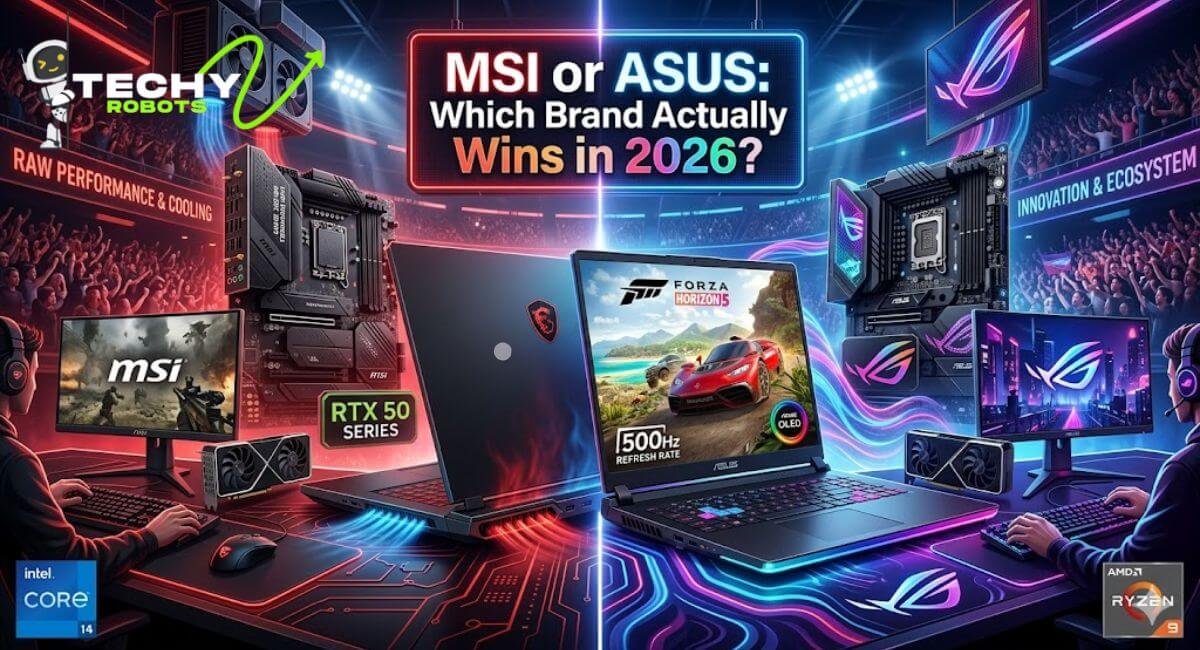
If you have ever gone down the rabbit hole of shopping for a gaming laptop or a new motherboard, you have probably hit this exact crossroads MSI or ASUS? Both brands are everywhere. Both have loyal fans who will argue their case until they are blue in the face. And honestly, both make some seriously impressive hardware. So what actually separates them?
This is not a simple answer, and anyone who tries to give you one probably has not spent much time with both. The truth is that MSI and ASUS each bring something different to the table, and the right choice really comes down to what you need, what you are willing to spend, and the kind of experience you want out of your machine. Let us break this down properly.
Why This Comparison Matters More Than Ever

The PC gaming industry in 2026 is moving faster than it ever has. With next-gen GPU support, DDR5 memory, PCIe 5.0 storage, and RTX 50 series graphics pushing boundaries, choosing the wrong brand can mean your system ages out faster than expected. This is not just about picking a cool logo or a pretty chassis; it is about long-term value, gaming benchmarks that hold up, and hardware that actually does what the marketing promises.
MSI and ASUS both sit at the top of the gaming hardware food chain, but they get there in different ways. Understanding those differences puts you in a much better position when your hard-earned money is on the line.
A Quick Look at Both Brands
The MSI Story
MSI, short for Micro-Star International, has been around since 1986. They started as a motherboard manufacturer and quietly built a reputation for reliable, performance-driven hardware. Over the decades, MSI expanded into gaming laptops, desktops, graphics cards, and monitors. Their MSI Stealth and Raider GE series became household names in the gaming community, and their motherboards like the MSI MPG and MAG lines earned respect for solid VRM power delivery and great overclocking features.
MSI tends to appeal to gamers who want no-nonsense performance. Their machines are usually built around Intel Core processors and Nvidia GeForce RTX graphics, with a focus on thermal management and raw horsepower.
The ASUS Story
ASUS was founded in 1989 and has grown into one of the most recognized names in consumer tech globally. Their Republic of Gamers (ROG) lineup is arguably the most iconic gaming brand in the world. ASUS also runs the TUF Gaming line for value-conscious buyers, the ZenBook for creatives, and the ExpertBook for business users.
Where ASUS really stands out is in the sheer breadth of its product range. You can get an ASUS device whether you are a competitive esports player, a video editor, a student, or a corporate professional. That kind of versatility is hard to match.
Gaming Laptops Face-Off: MSI vs ASUS
MSI Gaming Laptops: Built for Raw Power
MSI gaming laptops have always been about delivering maximum performance without overthinking the design. The Raider GE series is their flagship, typically packed with the latest Intel Core processors and Nvidia GeForce RTX graphics. These machines are not subtle; they are large, powerful, and designed for people who take gaming seriously.
The MSI Stealth series takes a slightly different approach, slimming down the chassis while still delivering respectable GPU cooling system performance. It is the kind of laptop you could actually take to a coffee shop without looking like you are hauling a small spaceship.
MSI also does well on refresh rate displays, with many of their gaming notebooks pushing 240Hz or higher on 1080p panels, and 165Hz on QHD displays. For competitive gaming, that kind of responsiveness makes a real difference.
ASUS ROG and TUF Series: The Gamer’s Favorite
ASUS ROG Series Deep Dive
The Republic of Gamers lineup from ASUS is what most people picture when they think of a premium gaming laptop. The ROG Zephyrus and Strix lines have been dominating gaming laptop comparison charts for years, and for good reason. ASUS pours serious engineering into these machines, think military-grade components, a robust GPU cooling system, and display options that range from 144Hz all the way up to stunning OLED panels.
ROG laptops often come with AMD Ryzen processors as an alternative to Intel, giving buyers real flexibility depending on their workload. Whether you lean toward Intel Core or AMD Ryzen, the ROG ecosystem has you covered. Gaming benchmarks consistently put ROG machines at or near the top of their price bracket.
ASUS TUF Series: Value Without Sacrifice
The TUF Gaming series is where ASUS really shines for budget-conscious buyers. These laptops use military-grade components and durability testing to deliver a machine that can genuinely take a beating. The TUF lineup might not have the same flashy aesthetics as the ROG series, but the performance-to-price ratio is outstanding.
For students, first-time PC gamers, or anyone who wants solid gaming laptop performance without spending a fortune, the TUF series is hard to beat. You still get Nvidia GeForce RTX graphics, solid cooling, and anti-glare displays at a price that does not require a second mortgage.
Cooling Technology: Who Keeps It Cooler?

Thermal management is one of the biggest factors separating a great gaming laptop from a frustrating one. No one wants to hit 95°C mid-game and watch their frame rates tank.
MSI’s Thermal Management Approach
MSI uses their Cooler Boost technology across most of their gaming lineup. It is a system that aggressively ramps up fan speeds and directs airflow across the CPU and GPU simultaneously. On paper and in practice, it does a solid job keeping temperatures manageable during extended gaming sessions. Their use of vapor chamber cooling in higher-end models like the Raider GE series is genuinely impressive.
ASUS Cooling Solutions Explained
ASUS takes a slightly more sophisticated approach with their IceCool and IceBlade fan technologies, which are engineered to reduce noise while maintaining solid thermal output. ROG laptops also benefit from liquid metal thermal compound on the CPU, which transfers heat more efficiently than standard paste. This is the kind of detail that shows ASUS takes thermal engineering seriously, and it shows up in the gaming benchmarks.
Display Quality and Refresh Rates
A gaming laptop is only as good as its screen, and both MSI and ASUS know this. ASUS tends to have a slight edge here simply because of their OLED and Mini-LED options in the ROG lineup. If you care about color accuracy, contrast, and a buttery-smooth visual experience, ASUS gives you more to work with.
MSI’s displays are no slouch, though. Their QHD panels with 165Hz refresh rates and full HD panels with 240Hz refresh rates are excellent for esports gaming laptops. The anti-glare coatings on MSI displays are some of the best in the industry, making them practical for real-world use beyond a darkened gaming room.
For 4K laptop display enthusiasts, ASUS again comes out slightly ahead with more options in their higher-end ROG and ZenBook lineups. But if pure refresh rate speed is your priority for competitive gaming, MSI holds its own very comfortably.
Keyboard and Audio Experience
MSI Keyboard and Nahimic Audio
MSI ships most of their gaming laptops with SteelSeries keyboards, which are genuinely well-regarded in the gaming community. Key travel is satisfying, the per-key RGB lighting is responsive, and the layout is designed with gaming in mind. MSI also bundles Nahimic audio software with most of their machines, which delivers a surprisingly rich 360-degree sound experience through standard laptop speakers.
ASUS Keyboard and Sound System
ASUS ROG laptops typically come with their own ROG-designed keyboards, which feel similar to Cherry MX-style switches in terms of feedback. The typing experience on higher-end ROG models is one of the best you will find on any gaming notebook. ASUS has also made strides in audio with Dolby Atmos integration and a four-speaker setup on their larger ROG models, creating an immersive audio experience that punches well above its price.
Motherboards: MSI vs ASUS for Your Gaming PC
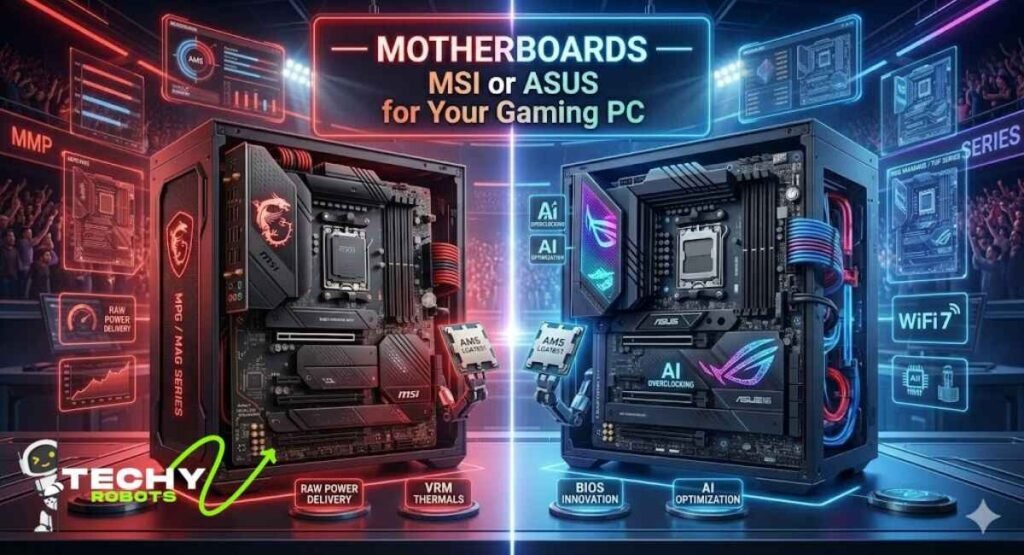
If you are building a desktop gaming PC rather than buying a laptop, the motherboard comparison between these two brands becomes even more important.
MSI MPG and MAG Series Motherboards
MSI’s MPG and MAG series boards are designed for gamers who want rock-solid stability without paying enthusiast prices. They support DDR5 memory, PCIe 5.0 storage, Wi-Fi 6E, and Thunderbolt 4 connectivity. The VRM power delivery on MSI’s mid-range boards is genuinely impressive, and their motherboard heatsinks do a great job of managing CPU thermal throttling during extended gaming sessions.
The MSI Carbon WiFi motherboard is a perennial favorite for mid-range builds, offering excellent PCIe Gen5 storage support and a clean aesthetic that works with most gaming PC builds. RGB lighting is tasteful but not overwhelming, exactly the balance a lot of builders are looking for.
ASUS ROG Maximus and TUF Motherboards
ASUS runs the full spectrum here, from the entry-level TUF Gaming boards all the way up to the ROG Maximus, which is about as premium as consumer motherboards get. The ROG Maximus line targets enthusiast overclocking, with features like extreme VRM configurations, massive heatsink coverage, and a BIOS that gives you granular control over every aspect of your system.
The ASUS TUF motherboards, like the MSI MAG line, offer that sweet spot for builders who want reliability without paying for features they will never use. Military-grade components mean these boards are built to last, and long-term reliability is something ASUS consistently delivers.
AI Overclocking and BIOS Interface
One area where ASUS has genuinely pulled ahead is AI overclocking. Their AI overclocking feature in the ASUS BIOS can profile your specific CPU and memory and automatically apply the optimal overclock settings. For builders who are not comfortable manually tuning, this is a massive quality-of-life improvement.
MSI’s BIOS interface is clean and well-organized, but it is more traditional in approach. Experienced overclockers will feel comfortable on both platforms, but ASUS gives beginners a smoother entry point into overclocking territory.
Build Quality and Durability
Both brands take build quality seriously, but they approach it differently. MSI gaming laptops feel solid and purposeful; the chassis might be plastic in some areas, but it never feels cheap. Their premium lines use aluminum and magnesium alloy construction, and the overall rigidity is excellent.
ASUS ROG laptops feel premium across the board, with most of their mid-range and above models using CNC-machined aluminum chassis. The hinge mechanism on ASUS laptops is notably smooth, and the overall fit and finish tends to edge ahead of MSI on close inspection. The TUF series, while using more polycarbonate in the chassis, still passes military-grade durability testing for things like vibration, drop, and humidity resistance.
Business and Productivity Laptops
ASUS ExpertBook and ZenBook
Outside of gaming, ASUS really shines with their business and productivity lines. The ASUS ExpertBook series is designed for corporate users who need reliability, long battery life, and security features like fingerprint readers and IR cameras. The ZenBook line caters to creatives with color-accurate OLED displays, compact designs, and enough CPU and GPU power to handle video editing and graphic design without breaking a sweat.
If you are comparing business laptop options, ASUS has significantly more depth here than MSI.
MSI’s Take on Professional Laptops
MSI does make business-oriented laptops; the Creator and Prestige series have carved out a niche among content creators who want performance in a portable package. However, the overall range is narrower compared to ASUS, and the brand recognition in the corporate space is not quite on the same level.
Warranty and Customer Support

Warranty and customer support is where neither brand is perfect, but both have improved significantly. MSI typically offers a one-year limited warranty on their laptops and motherboards, with options to extend. Their tech support experience has historically been a bit hit-or-miss depending on region, though improvements have been noticeable in recent years.
ASUS offers a similar warranty structure but generally has a larger and more established service network globally. Their customer support service response times tend to be faster in most markets, and their online support resources are well-maintained. For buyers outside of major tech hubs, ASUS often wins on service accessibility.
Price-to-Performance: Where Does Your Money Go?
At the entry level, both brands are competitive. An ASUS TUF Gaming laptop and an MSI Thin GF series machine at similar price points are both excellent value propositions: solid GPU performance, adequate cooling, and decent displays.
At the mid-range, the competition gets tighter. MSI’s Raider GE and ASUS ROG Strix G both offer strong gaming performance with similar specs, and the choice often comes down to personal preference in design and software ecosystem.
At the high end, ASUS ROG tends to offer more differentiated options, especially if you want OLED displays, advanced cooling solutions, or the very latest in next-gen GPU support. MSI’s top-end machines are excellent but have slightly less variety.
For motherboards, MSI often edges out ASUS at the mid-range value tier, while ASUS takes the crown at the premium end with the ROG Maximus lineup.
Which Brand Should You Pick in 2026?
Here is the honest answer: it depends on what you are buying and what matters most to you.
If you want a high-performance gaming laptop with great cooling and solid display options at a fair price both brands will serve you well. If display variety and brand ecosystem matter, ASUS gives you more to choose from. If raw cooling performance and a no-frills gaming experience are your priority, MSI delivers consistently.
For motherboards, ASUS wins at the top end with AI overclocking and premium design. MSI wins in the mid-range for value and reliability.
For business laptops, ASUS is the clear choice with the ExpertBook and ZenBook series.
For pure gaming desktop builds, it is genuinely close to whichever lineup has the best deal on the features your specific CPU and GPU need.
Conclusion
The MSI versus ASUS debate does not have a clean winner because these two brands compete differently depending on the product category. ASUS is broader, more versatile, and tends to push harder on innovation, particularly with ROG and their AI overclocking tech. MSI is focused, dependable, and delivers consistent gaming performance without overcomplicating things.
Both brands have earned their place at the top of the market, and both will continue to push each other toward better products in 2026 and beyond. The best thing you can do is figure out exactly what you need: gaming laptop, motherboard, business machine and then compare the specific models in that category. That is where the real answer lives.
At the end of the day, whether you go MSI or ASUS, you are getting hardware from a company that has been doing this for decades. Either way, you win.
FAQs
1. Is MSI or ASUS better for gaming laptops in 2026?
Both are excellent, but ASUS ROG offers more display variety including OLED options, while MSI tends to focus on raw cooling performance and competitive refresh rates. For most gamers, ASUS has a slight edge in overall options, but MSI holds its own on pure performance.
2. Which brand makes better motherboards — MSI or ASUS?
ASUS is generally considered superior at the high end with their ROG Maximus lineup and AI overclocking capabilities. MSI offers better value in the mid-range with their MPG and MAG series, especially for first-time builders who want reliability without a premium price tag.
3. Does ASUS have better customer support than MSI?
ASUS tends to have a broader service network globally, which gives them an advantage in most regions. MSI has improved in recent years, but ASUS generally offers faster response times and more accessible repair centers in most markets.
4. Are MSI laptops good for business use?
MSI offers the Creator and Prestige series for professionals, which work well for content creation. However, for traditional business use, ASUS ExpertBook and ZenBook laptops are purpose-built for corporate environments and offer better battery life, security features, and portability.
5. Which brand is more future-proof for gaming PC builds?
Both MSI and ASUS support the latest standards including DDR5, PCIe 5.0, Wi-Fi 6E, and Thunderbolt 4. ASUS has a slight edge on future-proofing features at the premium tier, but MSI mid-range boards offer excellent compatibility with next-gen components at a more accessible price point.