
AI can now create images that look almost identical to real photographs. From realistic portraits and product photos to fake news images and deepfakes, generated visuals are becoming harder for the human eye to spot.
That raises an important question:
How does AI detect fake images if humans often can’t?
The answer is that AI detection systems don’t look at images the way people do. Instead of focusing on whether an image “looks real,” they analyze hidden patterns, pixel level artifacts, metadata, compression signals, and statistical inconsistencies that often reveal how an image was created.
This guide explains exactly how AI image detection works, the technologies behind it, and why no detection method is currently 100% accurate.
How AI Image Detection Works
Most AI image detectors are machine learning models trained on large datasets containing both authentic photographs and AI generated images.
During training, the model learns subtle differences between real and synthetic images.
Rather than asking questions like:
- Does this face look real?
- Does this landscape seem believable?
The detector analyzes:
- Pixel distributions
- Texture patterns
- Noise signatures
- Lighting consistency
- Compression artifacts
- Image frequency data
- Metadata and provenance information
Over time, the system learns patterns that frequently appear in AI generated content but rarely appear in genuine camera photos.
The Main Techniques AI Uses to Detect Fake Images
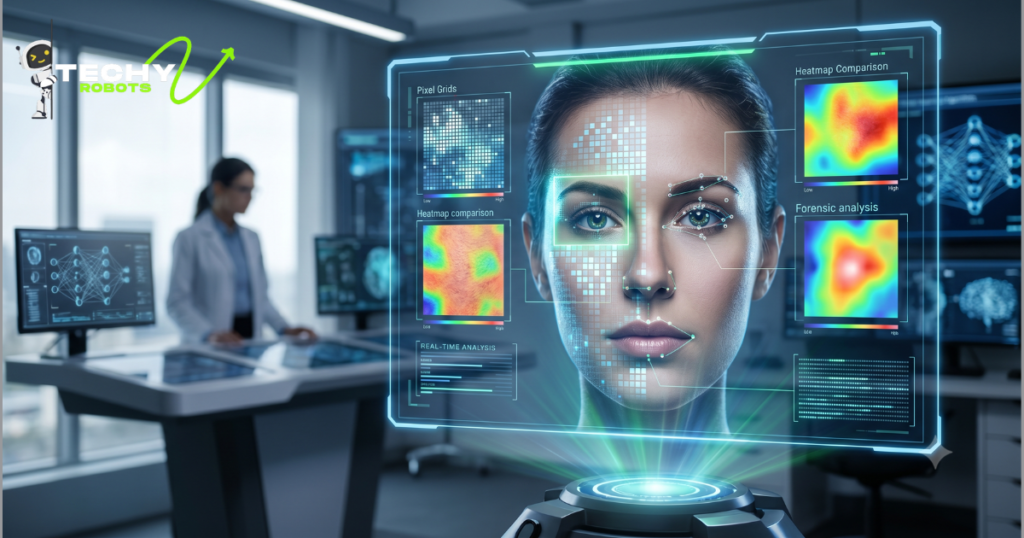
1. Artifact Detection
AI image generators often leave behind tiny imperfections.
Many of these flaws are invisible to people but detectable by machine learning systems.
Common examples include:
- Unnatural skin textures
- Distorted backgrounds
- Inconsistent shadows
- Strange reflections
- Irregular edges
- Blurred object boundaries
Even advanced generators such as Midjourney, DALL·E, Stable Diffusion, and Flux can leave statistical traces throughout an image.
Detection models are trained to recognize these recurring patterns.
2. Frequency Analysis
Real photographs and AI generated images often contain different frequency patterns.
Instead of examining visible objects, detectors analyze the image’s mathematical structure.
This process can reveal:
- Artificial texture generation
- Repeated visual patterns
- Synthetic noise distributions
- Generator specific fingerprints
Many modern detection systems use frequency domain analysis because these signals can remain detectable even when images appear realistic to humans.
3. Neural Fingerprinting
Some image generators leave unique signatures behind.
Researchers often call these signatures “AI fingerprints.”
Just as cameras have unique sensor patterns, AI models can produce recognizable output characteristics.
Detection systems may identify:
- Midjourney generated images
- Stable Diffusion outputs
- DALL·E generated content
- Other generative model families
In some cases, detectors can estimate which generator likely created the image.
4. Facial Analysis
Deepfake detection systems often focus on faces.
AI models analyze facial regions for inconsistencies such as:
- Eye reflections
- Skin texture abnormalities
- Facial landmark mismatches
- Unnatural expressions
- Asymmetrical features
- Blinking irregularities in videos
Convolutional Neural Networks (CNNs) are commonly used for this task because they excel at recognizing tiny visual differences across facial features.
5. Metadata and EXIF Analysis
Many images contain hidden information called metadata.
Metadata can reveal:
- Camera model
- Device information
- Editing software
- Creation timestamps
- Generation tools
Some AI generated images contain metadata indicating they were created with tools such as:
- Midjourney
- Stable Diffusion
- DALL·E
However, metadata alone is not reliable because it can be removed or modified easily. Many social platforms also strip metadata during uploads.
6. Reverse Image Search
Another detection method involves checking an image’s history online.
If a supposedly real photo has never appeared anywhere before and lacks a traceable source, it may deserve additional scrutiny.
Reverse image search tools help investigators:
- Find the original version
- Locate earlier uploads
- Identify edited copies
- Verify context
This method is commonly used by journalists and fact checkers.
7. Provenance and Digital Watermarking
One of the most promising solutions is image provenance.
Instead of trying to guess whether an image is fake, provenance systems verify where it came from.
Technologies such as:
- C2PA
- Content credentials
- SynthID
allow platforms and creators to attach authenticity information to images.
If the chain of ownership remains intact, viewers can verify whether an image originated from a camera or an AI system.
Visual Signs Humans Still Look For
Although AI detectors use complex algorithms, people often rely on visual clues.
Common signs include:
Strange Hands and Fingers
Hands remain one of the most common failure points.
Look for:
- Extra fingers
- Missing fingers
- Fused fingers
- Unnatural hand positions
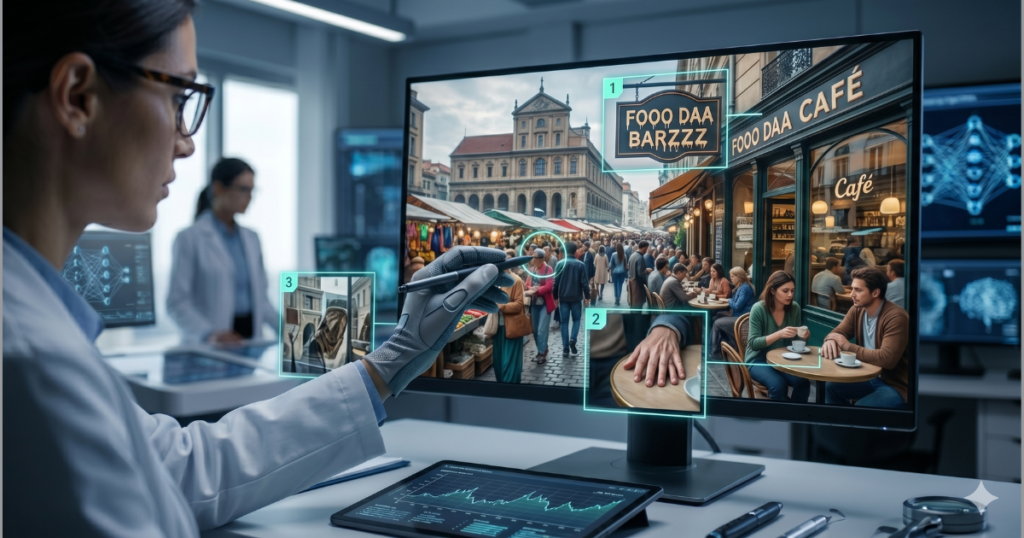
Garbled Text
AI often struggles with text inside images.
Signs include:
- Misspelled words
- Nonsensical letters
- Distorted signage
- Unreadable labels
Inconsistent Reflections
Check:
- Mirrors
- Glass surfaces
- Sunglasses
- Water reflections
AI sometimes generates reflections that don’t match surrounding objects.
Unnatural Background Details
Look closely at:
- Crowds
- Buildings
- Furniture
- Objects in the distance
Small details often reveal generation errors.
What Machine Learning Models Are Used?
Several types of AI models power fake image detection.
Convolutional Neural Networks (CNNs)
CNNs analyze visual features such as:
- Edges
- Shapes
- Textures
- Pixel relationships
They remain one of the most widely used detection architectures.
Vision Transformers (ViTs)
Vision Transformers analyze images by breaking them into smaller patches and examining relationships between those regions.
Many modern detectors use transformer based architectures because they often generalize better to new AI generators.
Hybrid Detection Systems
Advanced solutions combine:
- CNNs
- Transformers
- Frequency analysis
- Metadata inspection
- Source verification
This layered approach generally produces more reliable results than relying on a single method.
Are AI Image Detectors Accurate?
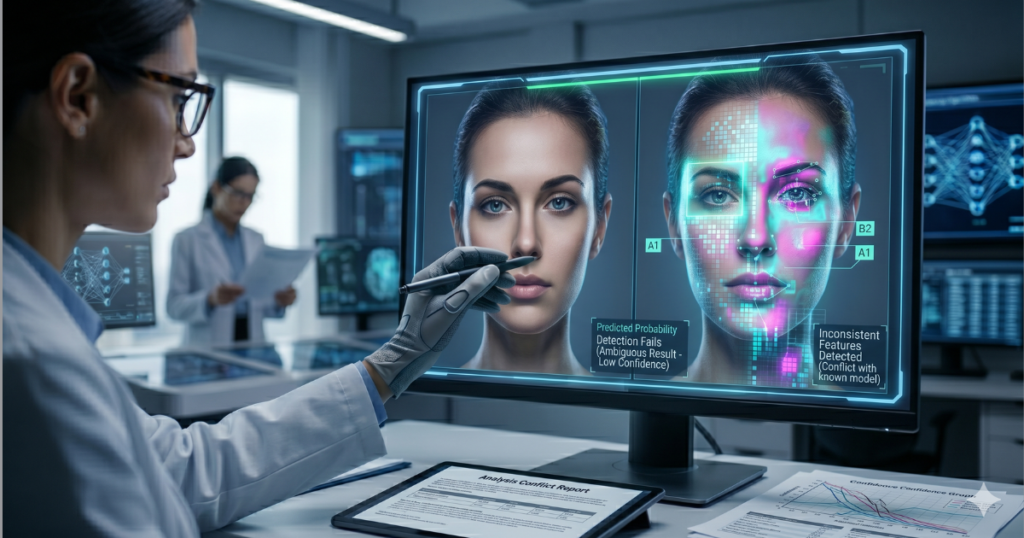
Not completely.
This is one of the biggest misconceptions about AI detection technology.
Many commercial tools advertise extremely high accuracy rates, but independent testing shows real world performance is often much lower.
Detection systems frequently struggle when:
- Images are compressed
- Screenshots are taken
- Images are cropped
- Filters are applied
- New generation models appear
Research and industry testing consistently show that no detector reliably identifies every AI generated image. Cross platform accuracy can vary significantly depending on the image source and generation method.
Why Detecting AI Images Is Getting Harder
Modern image generators improve rapidly.
New models can now create:
- Realistic skin textures
- Natural lighting
- Accurate anatomy
- Camera like depth of field
- Convincing photographic imperfections
As generation quality improves, detectors must continuously retrain on new data.
This creates an ongoing arms race:
- AI generators become more realistic.
- Detectors learn new patterns.
- Generators adapt to avoid detection.
- Detection systems evolve again.
Researchers describe this as a constant cat and mouse cycle.
Best Practices for Verifying Suspicious Images

If an image appears questionable, don’t rely on a single detector.
A better approach is to combine multiple verification methods:
- Run the image through several AI detection tools
- Check metadata when available
- Perform a reverse image search
- Examine visual inconsistencies
- Verify the source
- Look for content credentials or provenance data
- Cross check with trusted news sources
Professional fact checkers rarely depend on one signal alone. Instead, they combine technical analysis with source verification.
FAQs
Can AI always detect fake images?
No. Current detectors can identify many AI generated images, but none are perfectly accurate across all generators and editing scenarios.
What is the most reliable way to detect AI generated images?
A combination of methods works best, including AI detection tools, metadata analysis, reverse image search, and source verification.
Can AI generated images fool humans?
Yes. Multiple studies show people often perform only slightly better than random guessing when identifying high-quality AI-generated images.
Can fake images be detected after editing?
Sometimes. However, cropping, compression, screenshots, and filters can reduce detector accuracy and remove important signals.
Conclusion
AI detects fake images by analyzing patterns that humans typically can’t see. Modern detection systems examine pixel-level artifacts, frequency signatures, neural fingerprints, metadata, and source history to estimate whether an image was generated artificially.
The challenge is that image generation technology is improving just as quickly as detection technology.
Today, the most reliable strategy isn’t trusting a single detector. It combines automated tools, visual inspection, metadata analysis, and source verification to build confidence in whether an image is real or AI-generated.
As synthetic media becomes more common online, understanding how AI image detection works is becoming an essential digital literacy skill.