Picking between Gemini and ChatGPT in 2026 feels a little like choosing between two elite athletes competing in the same event. Both are incredibly capable. Both have evolved dramatically. And both are genuinely trying to become your default AI for everything. So the real question is not which one is smarter. The real question is which one is smarter for you.
This guide covers everything: benchmarks, pricing, coding, multimodal features, ecosystem integration, and business automation. No fluff, no vague summaries. Just a clear breakdown to help you decide where to put your money and your workflows.
Why This Comparison Matters More Than Ever in 2026
The AI landscape looks almost unrecognizable compared to just 18 months ago. OpenAI retired GPT-4o, GPT-4.1, and o4-mini back in February 2026, replacing them entirely with the GPT-5.x family. Google made a parallel leap moving from the Gemini 2.5 generation all the way to the 3.x lineup. Both platforms now sit at the frontier of what large language models can do.
What makes 2026 different is that these tools are no longer just chatbots. They’re becoming platforms. They’re handling documents, browsing the web, writing and running code, automating business workflows, and in some cases, literally taking control of your desktop. The stakes of picking the right one have never been higher for developers, businesses, and everyday users alike.
Meet the Contenders: What You’re Actually Getting
ChatGPT in 2026 vs GPT-5.5 Takes the Stage
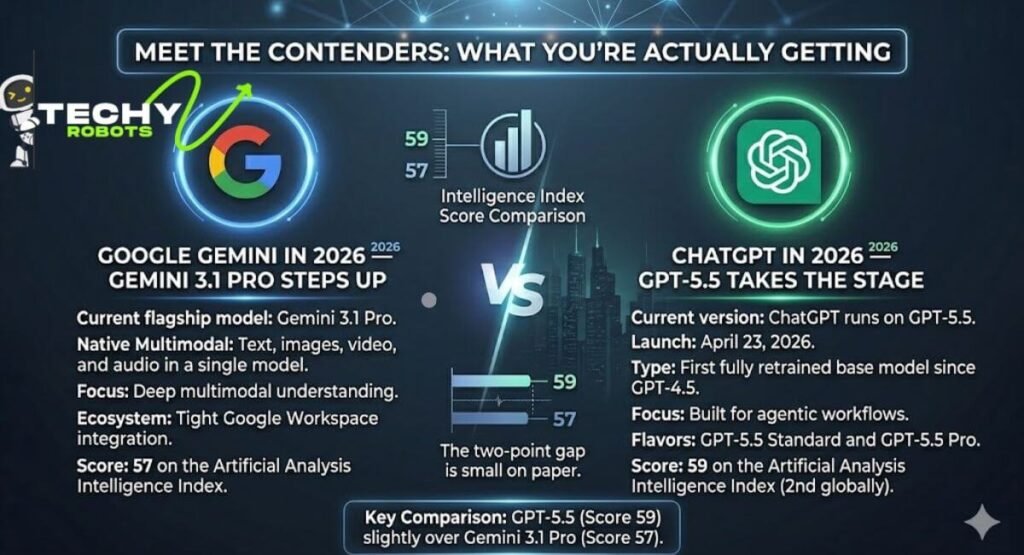
ChatGPT currently runs on GPT-5.5, which launched on April 23, 2026. This is OpenAI’s first fully retrained base model since GPT-4.5, and it was built from the ground up with agentic workflows in mind. It comes in two flavors, GPT-5.5 Standard and GPT-5.5 Pro, and replaced GPT-5.4 as the default across Plus, Pro, Business, and Enterprise plans. It scores 59 on the Artificial Intelligence Index, placing it second out of 141 models globally.
Google Gemini in 2026: Gemini 3.1 Pro Steps Up
Gemini 3.1 Pro is Google DeepMind’s current flagship. It was designed from scratch to handle text, images, video, and audio natively in a single model. The emphasis is on deep multimodal understanding and tight Google Workspace integration. On the same Intelligence Index, it scores 57 just two points behind GPT-5.5. That two-point gap sounds small on paper because it genuinely is.
Raw Intelligence: What the Benchmarks Actually Tell Us
Intelligence Index and Reasoning Scores
Here’s something most comparison articles skip over: that two-point gap between GPT-5.5 (59) and Gemini 3.1 Pro (57) on the Artificial Analysis Intelligence Index is essentially within the noise range of evaluation variance. You’re looking at two systems that are, for most practical purposes, equally intelligent at a general level.
GPQA, ARC-AGI-2, and Graduate-Level Tasks
Where ChatGPT pulls ahead is on complex chain-of-thought reasoning. On the GPQA Diamond benchmark which tests graduate-level problem solving across biology, chemistry, and physics, GPT-5.4 and 5.5 score higher and produce more structured, step-by-step explanations. Gemini 3.1 Pro is competitive but occasionally skips intermediate reasoning steps, blending multimodal cues and contextual shortcuts to arrive at answers faster though sometimes at the cost of depth on highly abstract problems.
Coding Performance — Which AI Should Developers Trust?
SWE-bench Verified and Real-World Code Tests
Both platforms hit roughly 80% on SWE-bench Verified, which means real-world coding performance is extremely close at the flagship level. Gemini 3.1 Pro scores 80.6% and GPT-5.4 scores approximately 80%. For Python, TypeScript, and Rust, ChatGPT generates slightly cleaner code with better first-pass architecture particularly on complex UI components and system design tasks.
That said, Gemini leads on LiveCodeBench Pro competitive coding, scoring an Elo rating of 2887 versus 2393 for GPT-5.2. For budget-conscious developers, the story gets interesting: GPT-5.4 Mini delivers 54.38% on SWE-bench Pro at about $0.40 per million input tokens, roughly six times cheaper than GPT-5.4 Standard. Gemini 3 Flash offers similarly cheap options for lighter tasks.
Agentic Coding and GitHub Integration
ChatGPT’s dedicated Codex agent is a standout here. It’s a standalone coding agent built for intensive developer workflows, and Gemini simply doesn’t have a direct equivalent yet. OpenAI’s Codex tier is clearly aimed at software teams doing serious production work repository analysis, multi-file refactoring, and automated debugging at scale. Gemini, however, offers tight native integration with Firebase, Google Cloud, and Android Studio, which makes it a natural fit for developers already inside the Google ecosystem.
Multimodal Capabilities: Who Handles More?
Image, Video, and Audio Understanding
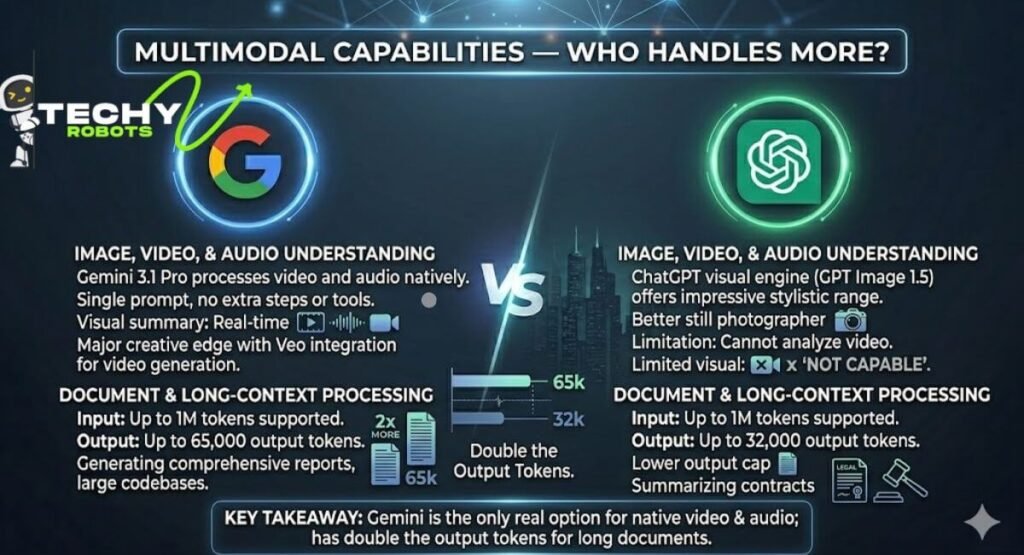
This is where the comparison gets lopsided. Gemini 3.1 Pro processes video and audio natively within a single prompt with no extra steps, no separate tools. ChatGPT still cannot analyze video. That’s not a small detail. If your work involves video content analysis, YouTube processing, meeting transcript review, or audio understanding, Gemini is not just better; it’s the only real option between the two.
For images, ChatGPT’s visual engine (GPT Image 1.5) offers an impressive stylistic range and clean prompt interpretation. Gemini’s integration with Veo for video generation gives it a major creative edge. Think of it this way: ChatGPT is the better still photographer, while Gemini is already shooting and editing video.
Document and Long-Context Processing
Both platforms support up to one million input tokens, but Gemini 3.1 Pro can generate up to 65,000 output tokens in a single response, more than double ChatGPT’s 32,000 token output cap. That matters enormously when you’re summarizing long contracts, generating comprehensive reports, or processing large codebases in one pass.
Context Window Comparison: Size Actually Matters Here
In the context window, Gemini wins without a close fight. Gemini 3.1 Pro supports up to two million tokens of context. ChatGPT Instant caps at 128K, with Pro and Thinking modes reaching up to 400K. If you regularly work with full codebases, lengthy legal documents, or hours of meeting transcripts, only Gemini handles that without chunking and context loss.
Think of the context window like your desk workspace. ChatGPT gives you a big desk. Gemini gives you a conference table. If you’re managing one document at a time, both are fine. If you’re juggling an entire project’s worth of material simultaneously, you’ll feel the difference.
Agentic AI Features: The Next Frontier
ChatGPT’s Computer Use and Desktop Automation
One of GPT-5.5’s most distinctive capabilities is desktop computer use. On the OSWorld-Verified benchmark, it scores 78.7% above the 72.4% human baseline. That means ChatGPT can literally take over your computer, navigate interfaces, fill forms, open applications, and execute multi-step workflows autonomously. This feature has no direct equivalent in Gemini right now, and it’s a genuine game-changer for anyone building or using automation-heavy workflows.
Gemini’s Agentic Web Search and Workflow Agents
Gemini leads on agentic web search. On the BrowseComp benchmark, Gemini 3.1 Pro scores 85.9% versus 65.8% for GPT-5.2. On multi-step professional workflow tasks (MCP Atlas benchmark), Gemini scores 69.2% compared to ChatGPT’s 60.6%. So while ChatGPT dominates desktop automation, Gemini dominates web-native agentic research and multi-step online workflows. They’re two different flavors of agentic AI, and knowing which flavor you need determines your winner.
Ecosystem Integration: The Dealbreaker Nobody Talks About
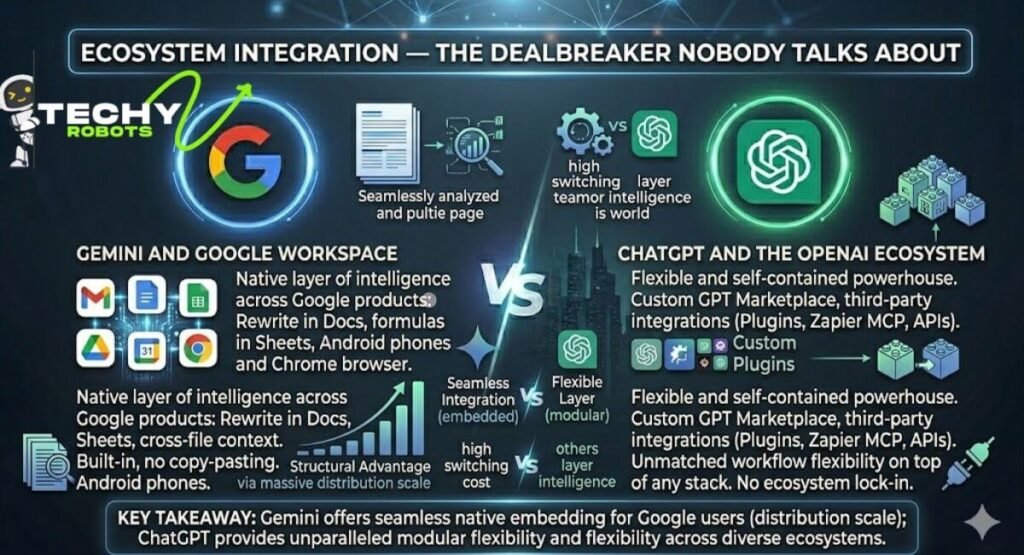
Gemini and Google Workspace
If you live and work inside Gmail, Google Docs, Sheets, Drive, and Calendar, Gemini isn’t just a nice add-on it’s a native layer of intelligence across everything you already use. Rewriting sections inside a Google Doc without leaving the document, generating formulas in Sheets on command, maintaining full context across a multi-page file none of that requires copy-pasting or switching tabs. It’s built into the tools.
Gemini is also embedded into Android phones and Chrome browsers, which means its distribution reach is enormous. Every Android device is a potential Gemini touchpoint, and that scale gives Google a structural advantage over OpenAI that benchmarks alone don’t capture.
ChatGPT and the OpenAI Ecosystem
ChatGPT’s ecosystem plays differently. Its Custom GPT marketplace is more mature, broader, and more flexible than Gemini’s equivalent Gems system. Third-party integrations via ChatGPT Plugins, Zapier MCP, and a growing catalog of API-powered tools give it unmatched flexibility for building specialized workflows outside of any single platform. It’s also more of a self-contained powerhouse; you don’t need to live in any particular ecosystem to get full value from it.
For teams not embedded in Google’s world, building a dependency on Google Cloud or Workspace just to access Gemini’s best features can feel like a high switching cost. ChatGPT lets you layer intelligence on top of whatever stack you already use.
Memory and Personalization: Does Your AI Remember You?
This is a meaningful differentiator. ChatGPT maintains persistent memory across sessions; it remembers your preferences, past projects, writing style, and ongoing instructions without being prompted every time. Over time, it genuinely learns how you work.
Gemini’s memory, by comparison, tends to reset between sessions and is more limited in scope. If you’re building an ongoing working relationship with your AI assistant, one where the tool gets better the more you use it, ChatGPT has a meaningful lead here. For users who primarily use Gemini through Google Workspace, the lack of cross-session memory is a friction point that adds up over time.
Pricing Breakdown: ChatGPT vs Gemini 2026
Consumer Plans: What You Pay Every Month
At the consumer level, the pricing is almost identical. ChatGPT Plus costs $20 per month and unlocks GPT-5.5, extended context, Custom GPTs, image generation via GPT Image 1.5, Sora 2 for video, Canvas, and Codex. Google AI Pro costs $19.99 per month, gives you Gemini 3.1 Pro with the full one-million-token context window, Gems, Imagen 4 for image generation, and deep Google Workspace integration plus, as of April 2026, it bundles 5TB of Google storage, doubled from the previous 2TB at the same price.
The premium tiers diverge more sharply. ChatGPT Pro sits at $200 per month. Google’s Ultra plan comes in at $249 per month. Both are aimed at heavy professional users and enterprise teams.
API Pricing: Where the Real Cost Gap Lives
Here’s where the comparison gets genuinely important for developers and businesses. On API pricing, Gemini is substantially cheaper, roughly 50% cheaper per input token, and the output token gap is even wider. GPT-5.5 charges $30 per million output tokens. Gemini 3.1 Pro charges $12 per million output tokens. That’s 2.5 times cheaper on the output side, and output tokens are where most API costs pile up in production applications, such as summaries, generated reports, long-form responses, and reasoning chains.
For a business generating five million output tokens per day, that cost difference is not trivial. It compounds fast. If you’re building API-powered products at scale, Gemini’s pricing structure deserves serious attention regardless of which platform you prefer as a user.
Business and Enterprise Use Cases
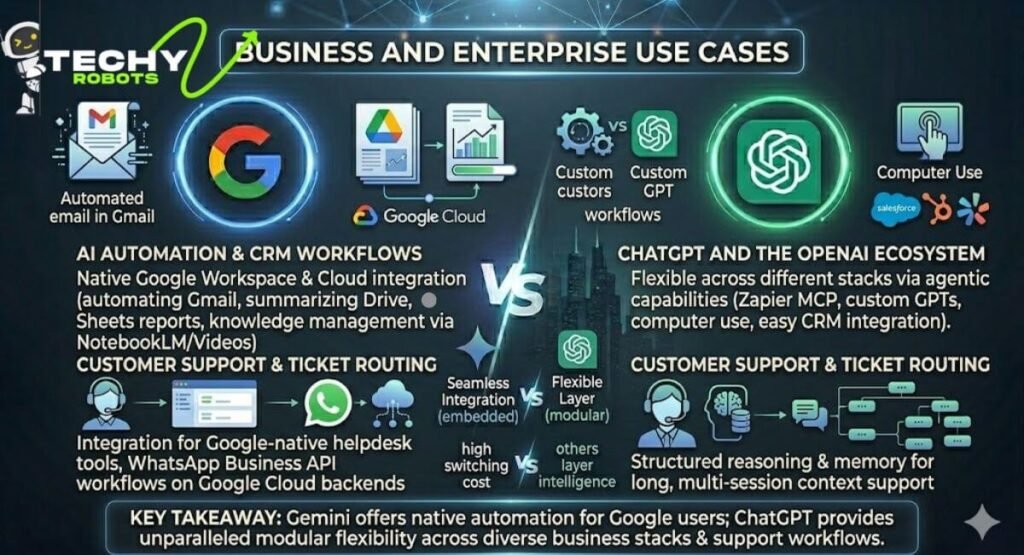
AI Automation and CRM Workflows
Both platforms are increasingly being used for business automation, but they approach it differently. Gemini’s native Google Workspace integration makes it a natural fit for companies already using Google’s productivity suite, automating Gmail responses, summarizing Drive documents, building Sheets-based reports, and integrating into Google Cloud pipelines. Tools like NotebookLM and Google Videos extend this further into knowledge management and video-based business content.
ChatGPT’s agentic capabilities through Zapier MCP integrations, custom GPT workflows, and computer use features make it more flexible across different business stacks. Teams using Salesforce, HubSpot, or other CRM platforms not in the Google ecosystem tend to find ChatGPT easier to integrate.
Customer Support and Ticket Routing
In customer support automation, both platforms can power AI agents that handle ticket routing, query classification, and first-response generation. ChatGPT’s structured reasoning and memory capabilities make it stronger for maintaining conversation context across long support sessions. Gemini’s tighter Google infrastructure integration makes it a better fit for teams using Google-native helpdesk tools or WhatsApp Business API workflows connected to Google Cloud backends.
Creative Writing and Content Generation
If writing quality is your primary concern, ChatGPT holds its edge. It produces more polished prose, follows nuanced creative instructions more reliably, and consistently delivers content with natural voice and tonal consistency. That’s not a small thing for writers, marketers, and content teams where the quality of the output directly impacts audience engagement.
Gemini holds its own and is genuinely strong on content generation, but on purely creative or narrative tasks, most independent tests give the edge to ChatGPT. The analogy that keeps coming up in community discussions is an apt one comparing ChatGPT and Gemini is a bit like comparing an iPhone to an Android. One is a tightly controlled, polished experience; the other is more open, integrated, and versatile. Which you prefer depends a lot on how you already work.
Who Should Pick ChatGPT?
Pick ChatGPT if you write code professionally and need the strongest agentic coding model. Pick it if you want a desktop computer use; it’s currently a unique capability with no Gemini equivalent. Pick it if creative writing quality matters and a natural voice in content is non-negotiable. Pick it if you want persistent AI memory that genuinely improves the longer you use it. Pick it if you work across diverse tools and need broad third-party integrations that aren’t tied to any single platform ecosystem.
Developers building autonomous multi-step workflows where the AI needs to control software or a computer will find GPT-5.5’s agentic architecture the better fit. And if your team is not already embedded in Google Workspace, ChatGPT lets you add AI capability without building new infrastructure dependencies.
Who Should Pick Gemini?
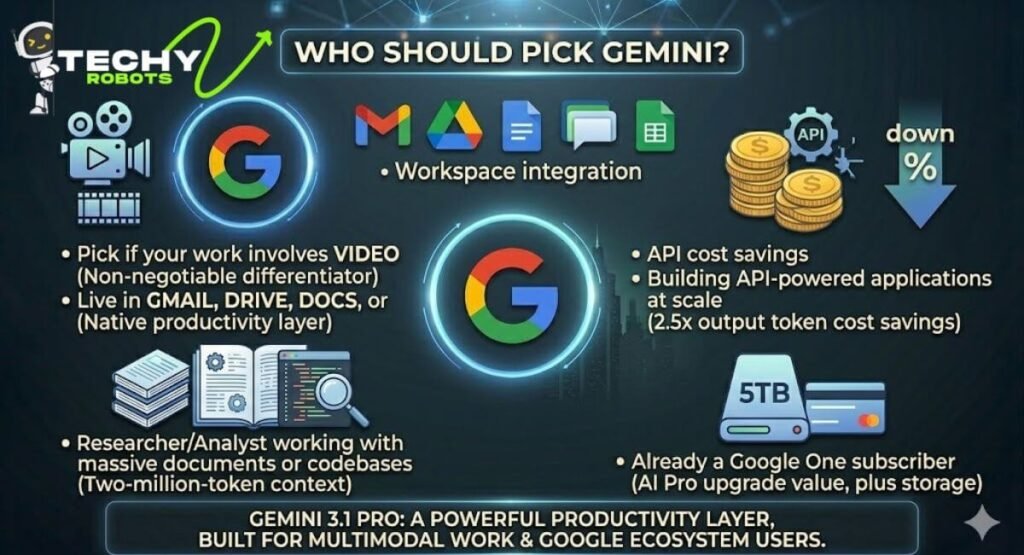
Pick Gemini if your work involves video. This is a non-negotiable differentiator ChatGPT cannot analyze video, and Gemini can. Pick it if you live in Gmail, Drive, Docs, or Sheets, where native integration turns Gemini into a genuine productivity layer rather than a separate tool you switch to. Pick it if you’re a researcher or analyst working with massive documents, full codebases, or long corpora where Gemini’s two-million-token context is genuinely necessary.
Pick it if you’re building API-powered applications at scale and the 2.5x output token cost savings matter to your business model. Pick it if you’re already a Google One subscriber upgrading to Google AI Pro at $19.99 gets you full Gemini 3.1 Pro access and 5TB of storage for just ten dollars more per month. That’s hard to argue with on value alone.
Conclusion
Gemini and ChatGPT in 2026 are closer in performance than ever, both offering strong reasoning, coding, and real-world workflow capabilities. The choice no longer depends on benchmarks but on how you work and what tools you rely on.
ChatGPT is better for deep reasoning, creative tasks, and productivity-focused users, while Gemini fits better within Google’s ecosystem and large data or media-heavy workflows. Many professionals now use both together, choosing the right tool for the right task.
FAQs
1. Is ChatGPT or Gemini better for coding in 2026?
Both score around 80% on SWE-bench Verified, making them very close on standard coding tasks. ChatGPT has a slight edge for production-grade code quality and offers a dedicated Codex agent for intensive developer workflows. Gemini leads on competitive coding benchmarks and is the better choice for developers inside the Google Cloud or Firebase ecosystem.
2. Which AI has the better free tier in 2026?
Gemini’s free tier is generally considered more generous. The free plan runs on Gemini 3 Flash, which handles a wide range of everyday tasks well. ChatGPT’s free tier now offers limited access to GPT-5.4, but usage caps are tighter. For users who don’t want to pay a subscription, Gemini gives more headroom.
3. Is Gemini cheaper than ChatGPT for API usage?
Yes, significantly. Gemini 3.1 Pro costs $2 per million input tokens and $12 per million output tokens via the API. GPT-5.5 costs $5 per million input tokens and $30 per million output tokens. For output-heavy production applications, Gemini is roughly 2.5 times cheaper where costs accumulate most.
4. Can ChatGPT analyze videos like Gemini?
No. Video analysis is currently exclusive to Gemini. Gemini 3.1 Pro processes video and audio natively in a single prompt. ChatGPT handles images and documents but lacks any native video understanding. If video is part of your workflow, Gemini is the only real option between the two.
5. Should I use both ChatGPT and Gemini?
Many professionals in 2026 do exactly that. ChatGPT excels at agentic desktop tasks, creative writing, memory-based personalization, and coding depth. Gemini excels at Google Workspace integration, video processing, long-context analysis, and cost-efficient API usage. Using both, strategically picking the right tool per task is quickly becoming the standard approach for teams serious about AI productivity.