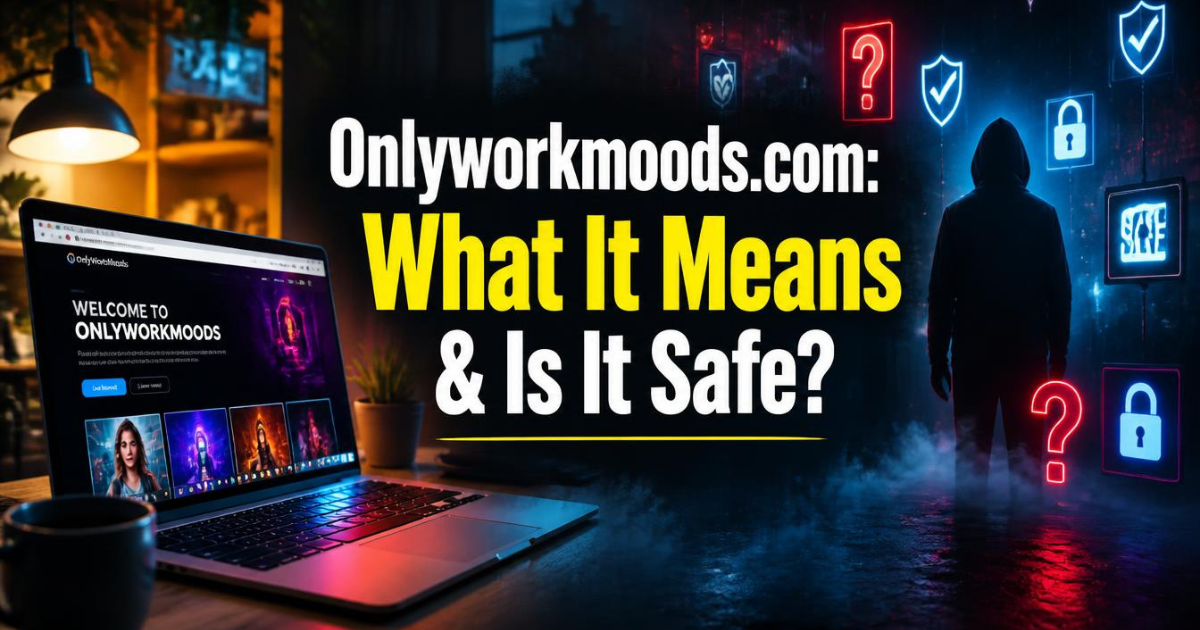
If “onlyworkmoods com” showed up in your search results or a group chat and you’re not sure what it is, this breaks down what the name likely represents, why it’s picking up search interest, and how to check any unfamiliar domain like this before you click into it.
What Does “Onlyworkmoods com” Mean?
Breaking the name down tells you most of what you need to know. It combines three distinct words:
- “Only” suggests a specialized or niche focus rather than a broad, general-purpose site
- “Work” ties it to jobs, freelancing, remote tasks, and daily employment
- “Moods” points toward feelings, mental energy, stress, and emotional state while working
Put together, it reads as a domain built around the intersection of workplace psychology and productivity, the idea that how you feel during the workday directly affects how well you work.
Why Are People Searching for This Domain?
There are a few likely reasons this term keeps showing up in searches:
- Someone saw the name somewhere (a forum, a group chat, a social post) and wants to know what it actually is before clicking a link.
- They’re looking for tools that match work to energy levels, doing lighter tasks during low-energy stretches and saving demanding work for peak focus hours.
- They’re checking safety first, a smart habit before opening any unfamiliar domain shared in a message or email.
Why Mood and Energy Actually Affect Work Output
This isn’t just wellness talk. There’s a real, well documented relationship between emotional state and cognitive performance. When you’re calm and reasonably engaged, your brain handles complex problem-solving and information processing more efficiently. Under acute stress, elevated cortisol makes short-term memory and focus noticeably harder to sustain, which is part of why the same task can feel effortless one day and exhausting the next.
Workplace research groups like Gallup have published ongoing work on employee engagement showing it correlates with better performance and lower burnout, though exact figures vary by study and year, so it’s worth checking their published reports directly rather than relying on a single cited number.
Remote Work Has Made This More Relevant
The shift toward remote and hybrid schedules changed how people experience the workday. Without office cues like a commute, coworker check-ins, or a clear physical boundary between “work” and “home,” a lot of remote workers report more difficulty disconnecting after hours and a harder time reading their own energy levels through the day.
That gap is exactly what mood-aware productivity tools and content are trying to address, giving remote workers a structured way to notice their own patterns instead of relying on office routines that no longer apply.
Emotional Intelligence as a Practical Work Skill
Emotional intelligence at work isn’t abstract. In practice, it just means knowing your own limits, recognizing when to push through a task and when a short break will actually get you further than forcing it. Workers who pay attention to this tend to communicate better under pressure and avoid the kind of burnout that comes from ignoring fatigue signals for too long.
How to Check Any New Domain Before You Trust It
Whether or not onlyworkmoods.com turns out to be the exact tool you’re picturing, the habit of checking a new domain before engaging with it is worth building generally. A simple four-step check covers most of what matters:
- Confirm HTTPS. The address should start with https:// and show a valid padlock in your browser bar.
- Check the domain’s age. A public WHOIS lookup tool shows when it was registered. Older, established domains carry slightly more built-in trust than brand-new ones.
- Don’t share more than you need to. A content or informational site has no legitimate reason to ask for a password or payment card just to browse.
- Use a private browsing window the first time you open an unfamiliar link, especially one sent through email or chat.
A Simple Way to Start Tracking Work Mood
You don’t need software or a paid app to try this. A basic version looks like this:
- Log your energy three times a day (morning, early afternoon, late afternoon) on a simple 1 to 5 scale.
- Match tasks to your pattern. Save demanding creative or analytical work for your highest-energy windows, and route routine tasks like email or admin work to your lower-energy stretches.
- Review after a week. A few days of logging is usually enough to spot your own natural rhythm and plan the following week around it.
What This Looks Like in Practice
A few examples of how this plays out for different kinds of remote work:
- A freelance writer hits a slump in the afternoon and switches to editing or research instead of forcing new drafting, saving heavier writing for the next morning.
- A remote developer schedules complex debugging during a personal peak-focus window and takes short breaks between review cycles to avoid mental fatigue.
- A virtual assistant batches quick client replies during a medium-energy stretch, keeping sharper focus available for detailed scheduling work later in the day.
Traditional Scheduling vs Mood-Aware Scheduling
Factor Fixed-Hours Approach Mood-Aware Approach Task scheduling Based on the clock, regardless of energy Matched to actual focus and energy levels Handling fatigue Push through, often with more caffeine Short, intentional breaks Burnout risk Higher, from sustained forced output Lower, with built-in recovery Consistency Uneven, depends on how the day feels More stable over time
Honest Limitations of This Approach
Mood-aware scheduling isn’t a fix-all, and it’s worth being upfront about where it falls short:
- Tracking alone doesn’t help. Logging your energy does nothing if you don’t actually adjust your schedule based on what you notice.
- Overthinking it can backfire. Waiting for the “right mood” before starting a task is just a more sophisticated form of procrastination.
- Deadlines don’t wait for your energy levels. Urgent client work sometimes lands on a low-energy day regardless, and in those cases, discipline still has to carry you through.
FAQs
What is onlyworkmoods.com?
Based on the name itself, it points to a niche concept around workplace emotional health, productivity, and remote work habits, tools or content built around matching work to how you actually feel, not just the clock.
Is it safe to visit an unfamiliar domain like this?
Apply the same basic checks you’d use for any new site: confirm HTTPS, check the domain’s registration age through a WHOIS lookup, avoid entering sensitive information unnecessarily, and consider opening it in a private browser window the first time.
Why does mood affect productivity?
Emotional state directly affects cognitive function. Calm, engaged states support better focus and problem-solving, while stress and fatigue measurably reduce short-term memory and attention.
How do niche, mood-focused platforms help remote workers?
They typically offer structured ways to track energy, plan tasks around personal rhythms, and build routines that replace the natural cues an office environment used to provide.
How do I start tracking my own work mood?
Rate your energy on a simple 1 to 5 scale a few times a day for about a week, then look back at the pattern and start matching harder tasks to your natural high-energy windows.
Conclusion
Onlyworkmoods.com reads as a niche concept sitting at the intersection of remote work and workplace emotional health, part of a broader shift toward matching tasks to actual energy levels instead of forcing steady output regardless of how you feel. If you’re checking out the domain itself, apply the same basic safety habits you would for any new site, and treat mood-aware scheduling as one useful tool among several, not a replacement for basic discipline when real deadlines land on a bad day.